Persian Carpet Buying Guide Dubai — Authentic vs Fake, Prices & What to Look For
Dubai Is One of the World's Top Persian Carpet Markets — and One of the Easiest Places to Buy the Wrong One
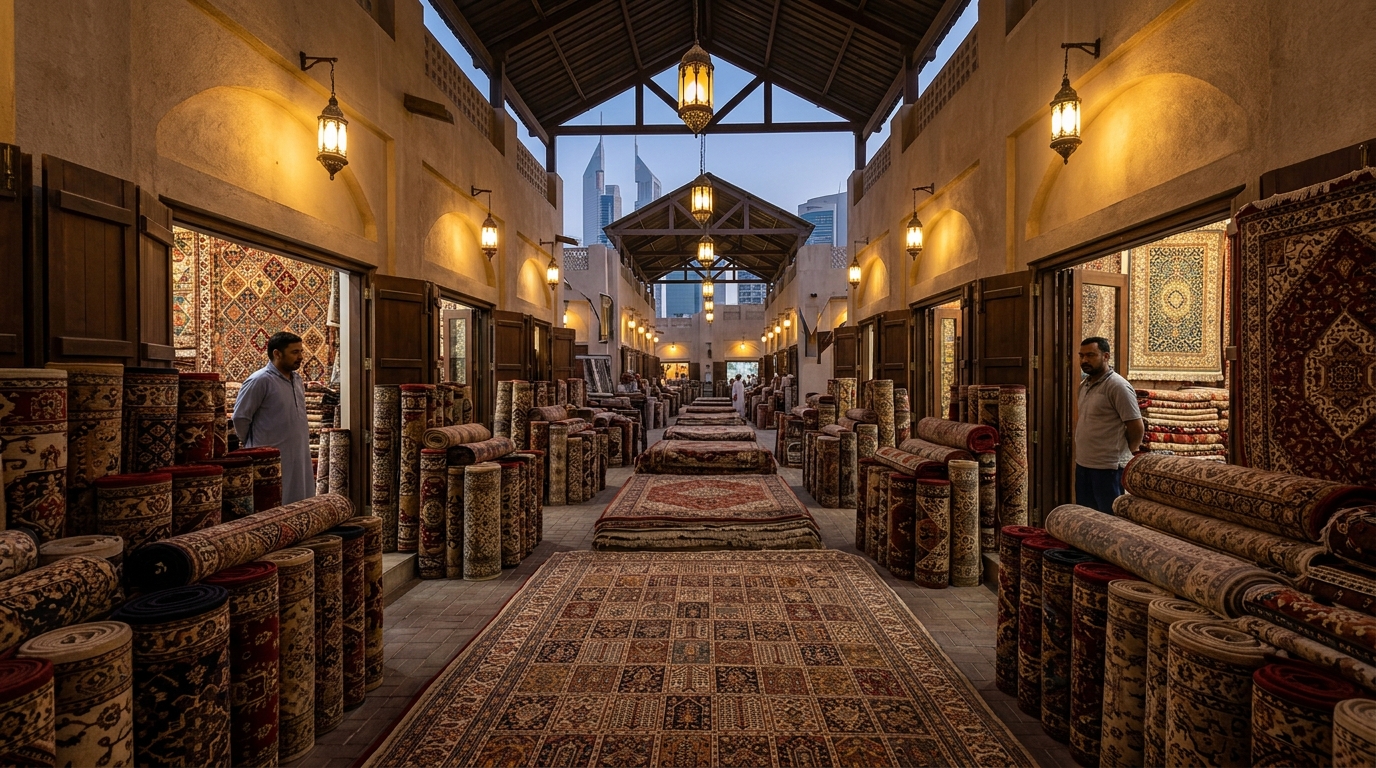
Dubai's position at the crossroads of the Gulf, Iran, and South Asia has made it one of the most active Persian carpet markets outside of Tehran. You can buy an authentic hand-knotted Isfahan here for AED 50,000 — or a machine-made imitation from the same design for AED 800. The difference between them is real, significant, and not always obvious to the untrained eye. This guide gives you the knowledge to tell them apart, know what to pay, and buy with confidence.
Quick answer: Authentic hand-knotted Persian carpets in Dubai range from AED 2,000 to AED 250,000+ depending on size, origin, age, and knotting density. The easiest authentication test: fold the carpet back and look at the knotting through the foundation. Hand-knotted shows asymmetric, individually tied knots. Machine-made shows perfectly uniform loops in a regular grid pattern.
🔍 Hand-Knotted vs Machine-Made Persian Carpets — How to Tell
This is the single most important distinction in Persian carpet buying. Getting it wrong is expensive. Here are six tests you can do at the point of sale:
The Back-of-Carpet Test (Most Reliable)
Turn the carpet over. Hand-knotted: you can see individual knots tied around the warp threads, each slightly irregular. Machine-made: perfectly uniform rows with no visible individual knots — it looks like a printed pattern. This test alone eliminates 90% of fakes.
📌 Hand-knotted = irregular back. Machine = uniform grid.
The Fringe Test
On authentic hand-knotted carpets, the fringe (the tassels at either end) is an extension of the carpet's foundation warp threads — it is part of the carpet. On machine-made carpets, the fringe is sewn or glued on separately after production. Pull gently at a fringe strand: if it slides out, it's sewn on = machine-made.
📌 Integrated fringe = authentic. Sewn-on fringe = machine.
The Colour Variation Test
Authentic Persian carpets show slight colour variations in the same dye lot — called "abrash". This is caused by different batches of hand-dyed yarn being used during the months or years of knotting. Machine-made carpets have perfectly consistent colour throughout. Slight tone variation is actually a mark of authenticity.
📌 Slight colour variation (abrash) = authentic sign.
The Symmetry Test
Look at the pattern from 2 metres away. An authentic hand-knotted carpet will have microscopic imperfections in pattern symmetry — human hands cannot tie 500 knots per square inch with machine precision. A machine-made carpet is perfectly symmetrical. Perfect symmetry in a claimed "handmade" carpet is a red flag.
📌 Minor pattern imperfections = authentic. Perfect = machine.
The Fibre Burn Test (Advanced)
With permission, pull a few pile fibres and hold to a flame. Wool burns slowly, smells like burning hair, and leaves a crushable ash. Silk burns instantly, smells like burning hair, and leaves a fine powdery ash. Synthetic fibres (polypropylene, polyester) melt, ball up, and smell chemical. This confirms the fibre claim.
📌 Wool = burns slowly, hair smell. Silk = flares instantly. Synthetic = melts.
The Knot Count / KPSI Test
KPSI (knots per square inch) determines quality within hand-knotted carpets. City carpets (Isfahan, Kashan, Qom) achieve 200–700+ KPSI. Village carpets reach 40–150 KPSI. To estimate: fold the carpet face-down and count the knot rows in one inch. More knots = finer detail possible = higher value.
📌 Higher KPSI = finer carpet = higher authentic value.
🗺️ Persian Carpet Origins — Isfahan, Tabriz, Kashan & Qom Explained
The region of origin is one of the most significant factors in Persian carpet valuation. Here are the four origins most commonly available in Dubai:
| Origin City | Style | Characteristic Patterns | Typical KPSI | Price Range in Dubai (AED) | Best For |
|---|---|---|---|---|---|
| Isfahan | City carpet — fine, formal | Medallion with arabesque, Shah Abbasi floral, interlaced palmettes | 200–450 | AED 8,000 – 120,000+ | Majlis rooms, formal reception areas |
| Tabriz | City carpet — bold, diverse | Garden design, medallion, hunting scenes, pictorial | 150–500 | AED 5,000 – 80,000+ | Living rooms, villas, investment |
| Kashan | City carpet — classical, refined | Medallion with dense floral field, central star medallion | 200–400 | AED 6,000 – 90,000+ | Dining rooms, master bedrooms |
| Qom (Qum) | City carpet — finest available | Silk on silk, garden, tree of life, extremely fine detail | 400–1,000+ | AED 15,000 – 250,000+ | Investment, display, luxury majlis |
| Gabbeh / Village | Village carpet — rustic, bold | Geometric, tribal, abstract, minimal detail | 40–120 | AED 1,500 – 15,000 | Contemporary interiors, eclectic design |
🔢 How Knotting Density Affects Persian Carpet Value
Knotting density (KPSI — knots per square inch) is the primary technical specification that determines the quality ceiling of a hand-knotted carpet. A higher KPSI allows finer curvilinear patterns, greater colour graduation, and more detail in figurative or floral motifs.
KPSI Benchmarks:
💡 Dubai Buyer Insight
Most UAE buyers are sold high KPSI claims without verification. The only way to estimate KPSI yourself: fold the carpet face-down, count knot rows along one inch of warp thread, then count knot rows along one inch of weft thread, and multiply. A carpet claiming 300 KPSI with only 15×15 visible knot rows per inch is actually 225 KPSI — worth significantly less.
💰 Authentic Persian Carpet Prices in Dubai (2026 AED Guide)
| Size | Machine-Made (Persian design) |
Hand-Knotted (Wool, village/city) |
Hand-Knotted Silk (Qom/city finest) |
|---|---|---|---|
| Small (120×80cm) | AED 300–800 | AED 1,500–6,000 | AED 5,000–20,000 |
| Medium (200×140cm) | AED 700–2,000 | AED 4,000–18,000 | AED 15,000–60,000 |
| Large (300×200cm) ⭐ Most popular | AED 1,500–4,500 | AED 9,000–45,000 | AED 35,000–120,000 |
| Extra Large (400×300cm) | AED 3,000–8,000 | AED 20,000–90,000 | AED 70,000–250,000+ |
* All prices are indicative AED retail ranges in Dubai for 2026. Antique carpets (50+ years old) command significant premiums beyond these ranges.
📜 What Certification Should a Dubai Persian Carpet Have?
⚠️ The Certification Reality in Dubai's Carpet Market
What reputable dealers provide:
- Origin certificate: Stating city/region of production and approximate production date
- Fibre declaration: Stating wool, silk, or cotton foundation and pile
- KPSI estimate: Based on physical inspection
- Written receipt: Itemising all claimed specifications
What does NOT exist (despite claims):
- There is no universal "Persian carpet authentication certificate" body
- No globally recognised grading system with independent verification
- Many certificates are dealer-generated — worthless for resale
- For investment-grade purchases above AED 50,000, commission an independent textile appraiser
🧹 How to Care for an Authentic Persian Rug in Dubai's Climate
Rotation — Essential in Dubai
Rotate your Persian rug 180° every 6 months. Dubai's UV — even through UV-filtering glass — causes one-directional fading. Rotation ensures even exposure across the whole carpet. This single habit extends colour life by years.
Vacuuming — Suction Only
Use suction-only — never a beater bar on hand-knotted rugs. The beater bar damages individual knot ties over time, loosening the structure. Vacuum against the pile direction first to lift embedded Shamal dust, then with the pile to restore appearance. Weekly minimum in Dubai.
Spills — Act in 60 Seconds
Blot (never rub) with a clean white cloth from the edge inward. For liquid spills, cold water only — heat sets stains permanently in natural fibres. Never use household carpet cleaners on hand-knotted rugs — the pH can damage natural dyes. For significant stains, call a professional natural fibre cleaner.
UV Protection in Dubai
Even through modern UV-protective glazing, direct sunlight degrades natural dyes in authentic Persian rugs. Position valuable rugs away from direct sun paths. In rooms with unprotected glazing, use UV-filtering window film (available from AED 30/sq ft installed in Dubai) for significant protection.
Moth & Pest Prevention
Wool Persian rugs are susceptible to moth damage in storage. In Dubai's year-round warm climate, moth larvae can be active. Store rugs in breathable fabric rolls (never plastic — moisture builds up), with cedar blocks or lavender sachets. Have stored rugs professionally aired every 6 months.
Professional Cleaning Cycle
Authentic Persian rugs should be professionally washed (not dry-cleaned) every 3–5 years by a specialist in natural fibre rugs. In Dubai, ensure the cleaner uses pH-neutral solutions and hand-washing techniques — machine washing damages knotting structure. Budget AED 15–40/sq ft for professional rug washing.
📋 Persian Carpet Buyer's Checklist — Before You Pay
❓ FAQ — Buying Persian Carpets in Dubai
💎 The Bottom Line on Buying Persian Carpets in Dubai
Dubai is an excellent market for Persian carpets — authentic pieces are accessible, the quality range is wide, and knowledgeable sellers exist. The risks are real too: the gap between authentic and machine-made is enormous at price level, and pressure selling exists in the market. Come prepared with the six authentication tests in this guide, know your KPSI benchmarks, and always get specifications in writing. For serious purchases above AED 10,000, ask Dubai Carpet Store for provenance documentation and take your time. See our authenticated Persian carpet collection — or WhatsApp us for a private viewing appointment.
View Our Authenticated Persian Carpet Collection
From AED 500 to AED 50,000+. Hand-knotted and machine-made options. Provenance documentation available. Private viewing appointments across Dubai.
📚 Related Guides & Products
Recent Blogs & Articles







Trusted Carpet Experts in Dubai
Premium Quality & Exceptional Service
At Dubai Carpet Store, we bring over 15 years of experience in delivering top-quality carpets and flooring solutions across Dubai and the UAE. Our focus is on comfort, style, and durability, ensuring your home or office gets the perfect carpet every time.
Free Dubai Delivery
Quick & safe transportation
Expert Installation
Professional fitting service
Quality Warranty
Guaranteed materials
Free Consultation
Expert advice included